What's the difference between a CT valve and a VT valve?
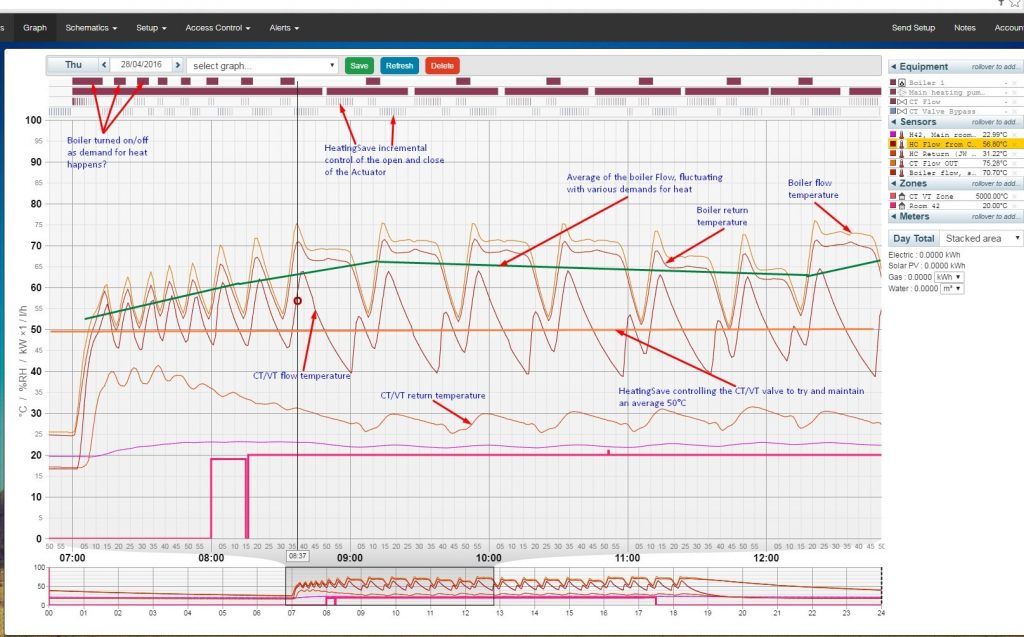
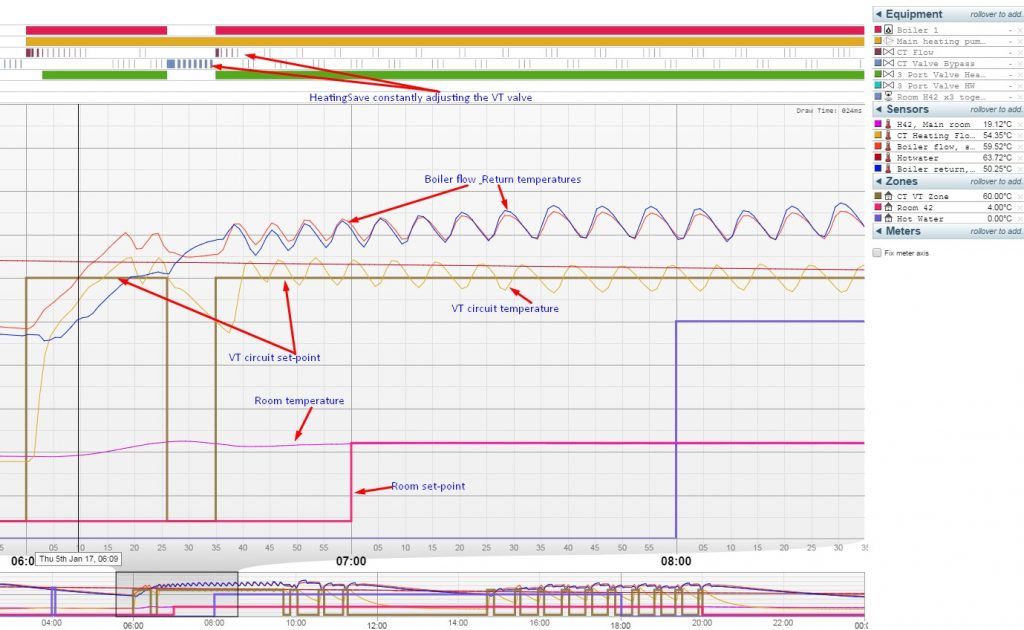
The important point here is that CT and VT valves are the same physical device. The only difference is the way in which they are logically used (i.e. in the HeatingSave software). In CT mode HeatingSave ties to maintain a Constant output temperature for the time that a particular heating hydraulic circuit is in operation. In VT mode HeatingSave maintains different output temperatures for the time that a particular heating hydraulic circuit is in operation, depending upon a Heating Pattern set point. Historically, CT/VT valves were often physically different devices because they came with their own (often mechanical) controller.
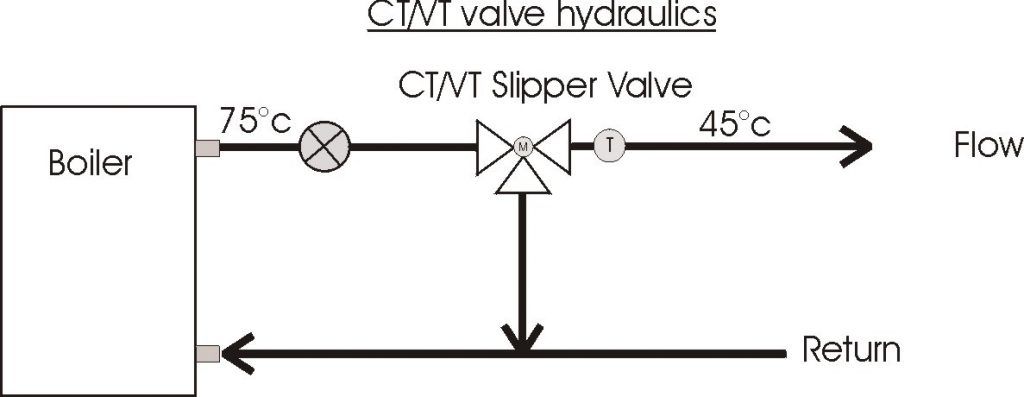
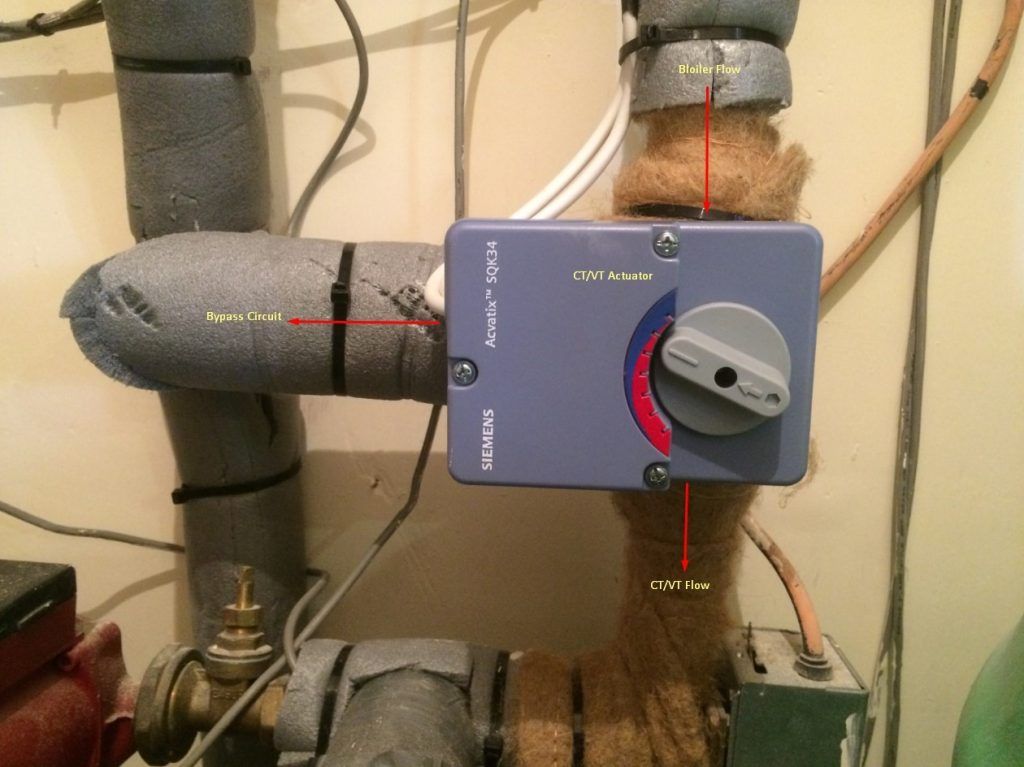
As shown in the photos above, each CT/VT valve has a valve body which is essentially a three-port valve on the boiler flow. The primary circuit water is proportionally diverted, via a slipper valve, either to the heating circuit where the CT/VT temperature is trying to be maintained, or to "bypass" which sends it back to the boiler Return.
Mounted on the valve body is an Actuator (in replacement of the red lever shown in Fig 2). This Actuator, using an electric motor, moves the slipper valve in one direction or the other (i.e. more "open" or more "closed"). This Actuator is in turn controlled by HeatingSave. Actuators typically have two methods by which HeatingSave can control them. Figure 7 below shows an example of an Actuator.
About 70% of the CT/VT Actuators installed in heating systems have two live 240VAC wires and a neutral wire. Here, if power is applied to one of the "live" wires the motor will move in one direction and if power is then removed from this "live" and put on the other "live", then the motor will move in the other direction. With two 204VAC relay outputs, HeatingSave can control the CT/VT valve. The HeatingSave software does the rest.
The other 30% of CT/VT valves provide proportional control to the CT/VT Actuators via a 0-10 VDC input. Here, HeatingSave varies the 0-10VDC DAC output (there are two DAC's on each T3520 and none on a T3516) to open and close the slipper valve. Although this can vary valve-to-valve, a 5 VDC supply would hold the mid position, 0 VDC would hold the valve fully open and 10 VDC would hold the valve fully closed (or vice versa).